Machine feedback starts with knowing what needs to be measured. Application photography supplied by TSM Sensors.Start with the measurement
What does your machine need to measure?
TSM manufactures industrial sensors for position and control measurements. Use the measurement—not just the machine name—to narrow the options. A single machine may need more than one sensor family.
Open a model below to compare its measuring range, interface, and installation requirements. Product and application details expand right here. Pricing, configuration, and availability are confirmed with your quote.
LINEAR TRAVEL
Cable extension transducers
Measure extension with a retractable cable attached to the moving part. Start here for telescoping booms and other long-travel mechanisms where an external cable route is practical.
CET5 CANopenUp to 5 m; extension and inclination feedback
A draw-wire transducer for measuring linear travel, with an integrated dynamic inclinometer. Consider it when both the extension and inclination of the mounting assembly are useful to the control system.
Measuring length
Up to 5 m (approximately 16.4 ft).
Primary interface
CANopen. TSM also lists CANopen Safety and SAE J1939 options; specify the required variant.
Cable construction
7 × 7 stainless-steel rope.
Listed features
Redundant outputs, reverse-polarity protection, and resistance to shock and vibration.
For your application: Provide the full travel and the cable path in both the extended and retracted positions. Confirm whether the inclination measurement refers to the part on which the sensor is mounted.
CET12 Analog / CANopenUp to 12.5 m; select the interface first
The CET12 family covers longer external travel than CET5. Analog and CANopen versions are listed separately; the same family name does not mean their electrical connections or outputs are interchangeable.
Measuring length
Up to 12.5 m (approximately 41 ft).
CET12 Analog
Analog position output. Confirm the required electrical output range and pinout.
CET12 CANopen
CANopen position feedback with an integrated dynamic inclinometer. CANopen Safety and SAE J1939 options are also listed by TSM.
Cable construction
7 × 7 stainless-steel rope.
For your application: Include controller details, full extension, mounting orientation, and the travel speed. Ask for the exact ordering code rather than specifying only “CET12.”
Manufacturer references: TSM CET12 Analog and CET12 CANopen; datasheets DS0003 and DS0001.
CET20 CANopenUp to 20 m; long-travel cable measurement
CET20 combines long-range draw-wire position measurement with an integrated dynamic inclinometer. Its extra reach makes it a candidate for longer telescoping mechanisms, subject to installation review.
Measuring length
Up to 20 m (approximately 65.6 ft).
Interface choices
CANopen; TSM also lists CANopen Safety and SAE J1939 variants.
Additional measurement
Integrated dynamic inclination sensing.
Listed features
Redundant outputs, reverse-polarity protection, and firmware upgrade capability.
For your application: Check the actual routing space, cable exit direction, retraction conditions, and required motion speed. A longer measurement range does not remove the need to protect the cable from interference.
Before choosing: Specify total travel, cable routing, retraction conditions, and the controller interface. A draw-wire sensor needs an unobstructed cable path.
A draw-wire sensor needs a practical connection to the moving part throughout the complete machine cycle. The available measuring length is only the starting point.
Travel envelope
Check the shortest and longest distance between the sensor and the attachment point, including overtravel.
Cable route
Review moving guards, hoses, articulation, side loading, and contamination along the complete route.
Signal choice
Match analog, CANopen, or a specified alternative to the actual controller; connector shape alone is not sufficient.
Documentation
Request the model datasheet and installation drawing for cable direction, mounting, electrical limits, and ordering options.
Selection guidance based on TSM CET5, CET12, and CET20 product information.
Measure angle relative to gravity rather than rotation between two machine parts. Consider this family for chassis inclination, boom angle, and platform leveling feedback.
TLP300 AnalogMEMS inclination sensing with analog output
TLP300 measures inclination relative to gravity. It combines accelerometers and gyroscopes with sensor-fusion processing rather than relying only on a simple static tilt measurement.
Output
Analog; confirm the exact signal range required by the controller.
Sensing technology
MEMS accelerometers and gyroscopes.
Mounting versions
Horizontal and vertical versions are listed.
Typical review points
Axes, measuring angle, mounting orientation, movement, and vibration.
For your application: Describe whether readings are taken while the machine is stationary or moving. The mounting version, filtering, response time, and accuracy need to match that operating condition.
Manufacturer reference: TSM TLP300 Analog product information; datasheet DS0031.
TLP300 CANopenInclination feedback for a CANopen network
The CANopen version uses the TLP300 MEMS sensing approach to report inclination to a networked control system. TSM lists CANopen Safety capability separately from the analog product.
Output
CANopen; specify when a CANopen Safety configuration is required.
Measurement
Angle relative to gravity, using accelerometer and gyroscope data.
Mounting versions
Horizontal and vertical versions are listed.
Listed features
Redundant outputs and reverse-polarity protection.
For your application: Provide the controller model, network requirements, number of axes, and working angle. For a safety function, request the documentation for the exact ordered version.
Other inclination productsContinuous angle, a tilt limit, or acceleration?
These measurements serve different control tasks. Start by identifying whether you need an angle value, a switched limit signal, or acceleration data.
TLA200 / TLP200 Analog
Other analog inclinometer families listed by TSM.
TLK100
A tilt-switch product with relay output, rather than a continuous angle signal.
TLP210 CANopen
An accelerometer product, not a direct substitute for an inclinometer.
Connections
Housing and connection customizations are available on request, subject to configuration review.
For your application: Describe the action your controller needs to take. This helps distinguish a leveling-feedback requirement from a simple tilt-limit switch or a motion-monitoring task.
Before choosing: State the number of axes and whether the machine measures while stationary or moving. TLP300 combines accelerometers and gyroscopes; verify performance for your motion profile.
Inclinometer selection & mountingReference angle, movement, and orientation
Decide what “level” means for the part being measured. A chassis, boom, and platform can each have a different angle, even on the same machine.
Reference point
Identify the assembly that carries the sensor and the angle your controller needs.
Static or moving
Describe acceleration, vibration, and whether readings are needed during motion or only after settling.
Orientation & axes
Match the horizontal or vertical version, measuring axes, and required angle span.
Signal or switch
Continuous leveling feedback needs a measurement signal. A tilt-limit decision may instead call for a switching product.
Selection guidance based on TSM TLP300 and inclination-product information.
Measure linear position using a contactless sensing principle. This is the starting point when the sensor must be integrated into a hydraulic cylinder rather than mounted outside the machine.
MAG100 / MAG200Threaded installation with an external sensor head
Both families use a threaded connection for integration into an oil-pressure cylinder, with the head remaining outside. The head profile and connection arrangement need to fit the cylinder drawing; do not assume MAG100 and MAG200 are mechanical replacements.
Listed Analog measuring length
Up to 2.5 m (approximately 8.2 ft).
Listed Analog operating pressure
Up to 350 bar.
Listed Analog temperature range
−40 to +85 °C.
Installation
Threaded connection; cylinder-integrated sensing element and external head.
For your application: Send stroke, pressure, thread and seal details, magnet arrangement, and head clearance. The limits above come from the Analog product descriptions; confirm the selected ordering code.
Manufacturer references: TSM MAG100 Analog and MAG200 Analog; datasheets DS0022 and DS0040.
MAG300Flange design for fully internal installation
MAG300 uses a flange connection and is designed to fit completely inside an oil-pressure cylinder. It addresses a different mechanical layout from the external-head MAG100 and MAG200 designs.
Listed Analog measuring length
Up to 2.5 m (approximately 8.2 ft).
Listed Analog operating pressure
Up to 350 bar.
Listed Analog temperature range
−40 to +85 °C.
Mechanical arrangement
Fully internal, flange-connected installation.
For your application: Review the cylinder-end geometry, flange retention, magnet position, electrical exit, and service procedure. The published Analog limits are not a substitute for the approved cylinder integration drawing.
Manufacturer reference: TSM MAG300 Analog product information; datasheet DS0024.
MAG Analog / CANopen optionsMatch the electronics as well as the mounting
TSM lists Analog and CANopen versions of MAG100, MAG200, and MAG300. Choose the mechanical layout and controller interface together, not as separate assumptions.
Analog versions
Match the exact signal range, supply requirements, and input configuration.
CANopen versions
Match the network and device configuration to the machine controller.
Safety requirements
Request the relevant safety documentation when a safety-related version is needed.
Replacement inquiries
Include the complete label and ordering code, not just the MAG family name.
For your application: Provide a wiring drawing or controller input specification along with the cylinder drawing. Ask us to identify the correct model-specific datasheet.
Before choosing: Provide stroke, cylinder pressure, mounting dimensions, and magnet arrangement. The MAG100, MAG200, and MAG300 Analog pages specify operating pressure up to 350 bar; confirm the exact configuration.
Cylinder-sensor integration checklistCylinder drawing, magnet, stroke, and wiring
Confirm the available cylinder geometry before selecting the sensor length. Useful measurement stroke and overall sensor length are not the same dimension.
Mechanical fit
Identify threaded/external-head or fully internal/flange installation.
Position reference
Define usable stroke and the magnet or cursor location across the travel.
Operating conditions
State working pressure, pressure peaks, temperature, vibration, and fluid exposure.
Service & wiring
Review access for assembly and replacement, cable exit, connector clearance, and controller inputs.
Selection guidance based on TSM MAG100, MAG200, and MAG300 product information.
Measure the rotation of a shaft or mechanism. Use rotary position feedback for steering pivots, rotating assemblies, and other joints where relative angular position is the measurement you need.
RTA100 uses contactless magnetic sensing in a shaft-type encoder. Its sensing element measures angular position without a sliding electrical contact.
Measurement type
Single-turn absolute rotary position.
Mechanical arrangement
Shaft-type encoder in an anodized-aluminum housing.
Interface
CANopen; TSM also lists SAE J1939 output options.
Listed features
Redundant outputs, reverse-polarity protection, and firmware upgrade capability.
For your application: Provide the shaft connection, mounting pattern, rotation range, speed, and controller interface. Confirm how many revolutions need to be tracked; single-turn position does not itself count accumulated turns.
RTB100 provides contactless magnetic rotary-position sensing without the shaft arrangement used by RTA100. The machine-side rotor and the stationary sensor need a defined installation relationship.
Measurement type
Single-turn absolute rotary position.
Mechanical arrangement
Shaftless design with anodized-aluminum housing.
Interface
CANopen; TSM also lists SAE J1939 output options.
Listed features
Redundant outputs, reverse-polarity protection, and firmware upgrade capability.
For your application: Confirm the specified magnet or rotor, gap, alignment, and surrounding metalwork from the installation drawing. Do not choose it solely because the sensor body fits the available space.
RTS100 CANopenRotary position and inclination in one device
RTS100 combines single-turn absolute rotary-position measurement with inclination sensing. TSM describes a compact plastic housing with a diameter of 50 mm.
CANopen, CANopen Safety, and SAE J1939; confirm the exact version.
Applications to review
Steering or pivot position where inclination information is also useful.
For your application: Specify both measurements independently, including their reference points and controller requirements. Request model-specific safety documentation when the device is part of a safety function.
Before choosing: Define the rotation range and mechanical connection first. For a separate-magnet design, check the specified magnet, alignment, and mounting gap—not just the output protocol.
Rotary encoder selection & integrationShaft, magnet, angular range, and controller
First decide whether the machine needs shaft-coupled sensing or a shaftless arrangement. Then match the angular measurement to the electrical interface.
Mechanical layout
Compare shaft mounting with a separate rotor or magnet arrangement.
Required position
Specify the angular range, direction, reference position, speed, and any need to track multiple turns.
Additional tilt data
RTS100 adds inclination sensing; rotary position and tilt remain distinct measurements.
Replacement checks
Match the ordering code, pinout, signal protocol, and installation dimensions—not just the housing diameter.
Selection guidance based on TSM RTA100, RTB100, and RTS100 product information.
Check the exact configuration. Measuring range, output, accuracy, ingress protection, and safety capability vary by model and ordering code. A shared family name does not establish compatibility. Use the current datasheet and required approvals for the part being quoted.
Application guide
Connect the measurement to your equipment
The examples below translate TSM's application areas into the questions to resolve before ordering. They are starting points for an application review, not validated machine designs.
Cranes, telehandlers & access platforms
Boom extension and boom angle are different measurements. A cable transducer can provide extension feedback, while an inclinometer provides angle relative to gravity. Cylinder-integrated sensors are another option when the design calls for stroke feedback.
Measurement points on lifting equipmentBoom extension, angle, cylinder position, and rotation
Separate the motion into the measurements the control system needs. A crane or access platform often needs several feedback points, not one “crane sensor.”
Telescoping boom
A cable transducer can measure external extension; an inclinometer measures tilt relative to gravity.
Hydraulic movement
A cylinder-integrated MAG sensor provides stroke feedback where the cylinder design allows it.
Rotating mechanism
A rotary encoder can report position at a pivot or rotating assembly.
Application examples
TSM lists truck-mounted cranes, telehandlers, scissor lifts, hooklifts, and aerial work platforms.
Send with your inquiry: A drawing or photo of the moving sections, required travel and angles, mounting points, controller details, and any required safety documentation.
Manufacturer reference: TSM Handling and Lifting applications. Measurement matching is selection guidance, not a validated lifting-system design.
Agricultural machines can need steering-angle, vehicle-inclination, and actuator-position feedback on the same machine. Separate these tasks before choosing a sensor: rotary encoders, inclinometers, and cylinder transducers solve different parts of the job.
How sensors fit agricultural machinerySpray-boom angle, actuator stroke, and steering
An agricultural sprayer illustrates how different sensor families work together. TSM identifies inclination, cylinder position, and rotary angle as separate feedback tasks.
Spray-wing inclination
Inclinometers provide wing tilt-position feedback.
Spray-wing height adjustment
Magnetostrictive sensors monitor the hydraulic movement used for height adjustment.
Folding wings & steering
Rotary encoders provide boom open/close position and steering feedback.
Operating conditions
Describe vibration, washing, chemical exposure, and the location of the sensor and cable connections.
Send with your inquiry: The mechanism to be measured, stroke or angle, output requirements, and whether you need a prototype or a production quantity.
Manufacturer references: TSM Agricultural Vehicles and Agricultural Sprayer application information.
Identify the joint, boom section, or cylinder that needs feedback. Then review the actual shock, vibration, temperature, and cable exposure at that mounting point. Selecting by machine type alone is not enough.
Measurement points on an excavatorCylinder stroke, bucket rotation, and boom angle
TSM’s excavator example assigns different sensing technologies to different parts of the movement. That is a useful starting point for reviewing an earthmoving application.
Hydraulic cylinder
Magnetostrictive sensing monitors cylinder stroke from inside the cylinder.
Bucket angle
A rotary encoder measures angular position at the rotating mechanism.
Boom angle
An inclinometer measures boom inclination.
Installation review
Document shock, vibration, temperature, protected cable routing, and service access at each mounting location.
Send with your inquiry: Identify the exact arm section, pivot, or cylinder. Include the working travel, controller, and mounting drawing rather than relying only on the excavator model.
Manufacturer references: TSM Construction and Earthmoving and Excavator application information.
Marine hydraulic structures need position feedback matched to their movement and installation. Include salt exposure, washdown, connector location, and any vessel or equipment approval requirements in the inquiry. Do not assume a general industrial rating covers the application.
Position feedback for marine equipmentTenderlift cylinders, gangways, and hydraulic cranes
TSM lists tenderlifts, gangways, and hydraulic cranes among its marine applications. Begin with the movement that needs feedback, then review the environmental requirements for the actual installation.
Tenderlift leveling
TSM describes magnetostrictive cylinder-position feedback for automatic tenderlift leveling.
Gangways & cranes
Identify whether the control task needs extension, angle, or cylinder stroke before selecting a family.
Exposure
State saltwater exposure, washdown, immersion risk, cable location, and connector protection.
Approvals
Identify any vessel or equipment requirements so documentation can be checked for the exact part.
Send with your inquiry: Cylinder or mechanism drawings, travel, controller interface, quantity, and environmental conditions. A product’s industrial rating alone does not establish suitability for every marine installation.
Manufacturer references: TSM Marine and Tenderlift application information.
Cylinder manufacturers and rotary-assembly builders need to consider the mechanical integration as early as the electrical interface.
TSM hydraulic-cylinder application illustration.
Hydraulic cylinder manufacturers
TSM's MAG range includes threaded and fully internal flange designs. Share a cylinder drawing, stroke, pressure, and the space available for the sensor head and connections. The choice affects the cylinder design, magnet arrangement, and service access.
Plan a cylinder-integrated sensing solutionChoose the mechanical arrangement before finalizing the cylinder
Cylinder-integrated feedback should be reviewed while the end-cap, rod, and connection layout can still be adjusted. A retrofit inquiry also needs a clear view of what cannot change.
Start with the drawing
Provide bore and rod geometry, stroke, end-cap arrangement, and the space for the sensing element.
Choose the layout
MAG100 / MAG200 use threaded external-head arrangements; MAG300 uses a fully internal flange design.
Verify the magnet
Define the magnet or cursor arrangement, position along the travel, and the sensor reference.
Plan the electrical exit
Include connector location, sealing, harness protection, and access for maintenance.
For a production project: Include prototype quantity, annual usage, target dates, and test requirements. Exact fit and operating limits require a model-specific review.
Manufacturer references: TSM Hydraulic Cylinders applications and MAG product descriptions.
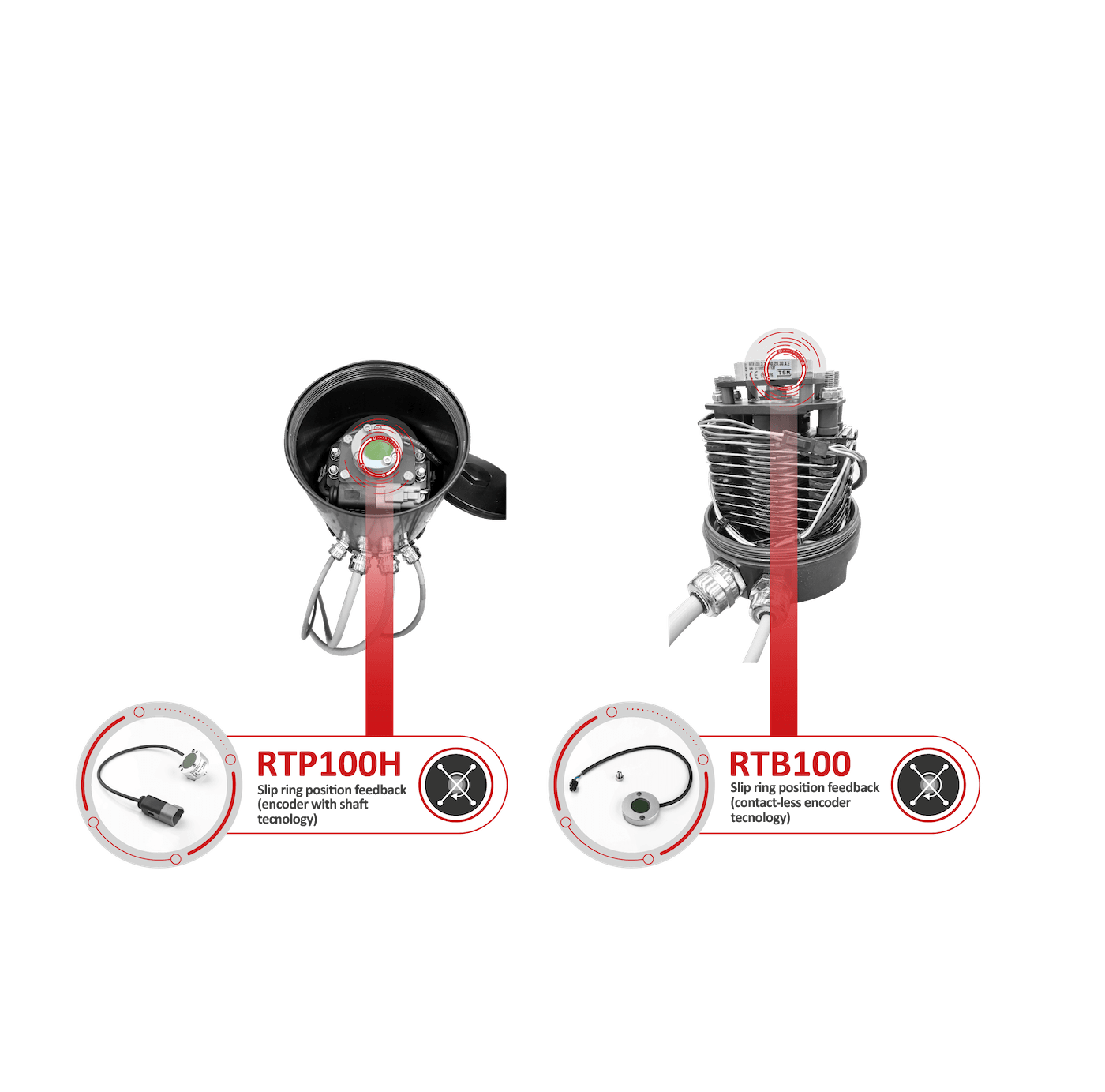
The slip ring transfers power or signals; the encoder adds angular-position feedback. TSM describes shaft-mounted and separate-magnet solutions for this integration. Provide the available envelope, shaft or rotor arrangement, and signal interface for review.
Add position feedback to a rotary assemblyKeep power transfer and position sensing separate in the specification
A slip ring transfers power or signals between fixed and rotating structures. The encoder adds angular-position information; it does not replace the slip ring’s electrical-transfer function.
Mechanical options
TSM describes shaft-mounted and separate magnetic-rotor arrangements for slip-ring integration.
Installation envelope
Provide the available diameter and length, shaft or rotor dimensions, and stationary mounting points.
Position requirements
Specify operating speed, angle range, reference position, and whether accumulated revolutions must be tracked.
Signal integration
Identify the controller interface and how the feedback is routed through the assembly.
Send with your inquiry: A cross-section or assembly drawing, mounting tolerances, and the intended encoder output. Confirm alignment and gap requirements for the selected design.
Manufacturer reference: TSM Electrical Slip Ring Manufacturers application information.
A CAN-bus input/output expansion unit for collecting input states and controlling outputs through a master. TSM also describes an optional programmable-master role. Review the I/O and system architecture before treating it as a controller replacement.
CAN.I/O.100 functions & integrationInput/output expansion, diagnostics, and an optional master role
In its expansion role, CAN.I/O.100 collects input states and sends them to a master. The master can then command outputs. TSM also describes internal checking and diagnostics.
Communication
CAN-bus interface; TSM lists CANopen and CANopen Safety capabilities.
Optional master operation
User-defined logic can operate on input states and control outputs.
Programming approach
TSM describes C-language programming with an open-source IDE for the optional master role.
Before specifying
Confirm I/O counts and types, output loads, electrical limits, firmware, and the intended controller architecture.
For your application: Send an I/O list and a system diagram. The optional programmable role should be reviewed as part of the control design, not assumed to be a drop-in replacement for an existing controller.
TSM develops made-to-measure sensors and integrated systems that can include electronic devices, distribution boxes, and cabling. Send the design constraints and expected quantity to start a feasibility discussion; customization is subject to review.
Custom sensor & integrated-system optionsDefine what a standard product cannot do
TSM describes made-to-measure sensors and integrated systems that can include electronic devices, distribution boxes, and structured cabling. The starting point is a defined requirement, not a blanket promise that every feature can be customized.
Mechanical constraints
Available space, mounting, connection arrangement, and the movement to be measured.
Electrical requirements
Required measurements, supply, controller interface, harness layout, and diagnostic needs.
Project scope
Identify whether you need a sensor variation or a coordinated sensing-and-wiring assembly.
Commercial information
Prototype quantity, expected annual volume, target timing, and required validation.
Next step: Describe where a standard family falls short. Feasibility, engineering scope, pricing, and schedule are confirmed after the requirements are reviewed.
Manufacturer reference: TSM Made-to-Measure Integrated Systems capabilities.
A matching output connector is not enough. Use this checklist to make an inquiry useful without needing to finish the entire specification first.
Sensor selection checklist
Requirement
What to provide
Why it matters
Measurement & motion
Linear travel, cylinder stroke, tilt, or rotary position; stationary or moving during measurement.
Angle relative to gravity is different from the rotation between two parts. Dynamic movement also affects the application review.
Range & accuracy
Minimum and maximum position, units, and allowable error. “Not yet defined” is fine.
Resolution, repeatability, and accuracy are different specifications. Ask for the one the control task actually requires.
Electrical interface
Controller model, supply voltage, required output, connector, and pinout.
CANopen, CANopen Safety, SAE J1939, and analog signals are not interchangeable. Availability is model-dependent.
Installation & environment
A drawing or photo, mounting space, cable routing, temperature, shock, vibration, and fluid exposure.
The installation can rule out a sensor that otherwise matches the electrical and measurement requirements.
Safety requirements
The required safety function and any specified SIL, PL, or communication requirement.
A safety-capable sensor does not make an entire machine safety-rated. Confirm the exact product documentation and system validation requirements.
Quantity & timing
Prototype quantity, expected annual usage, and the target delivery date.
This distinguishes a replacement-part inquiry from a production design and helps define the quote.
Common questions
Choosing and quoting TSM sensors
What is the difference between an inclinometer and a rotary encoder?
An inclinometer measures angle relative to gravity. A rotary encoder measures angular position of a rotating element. For example, a machine's tilt on a slope and the position of its steering pivot are separate measurements. Some TSM products combine sensing functions; check which outputs the specific model provides.
Should I use a cable transducer or a magnetostrictive cylinder sensor?
Start with the installation. A cable extension transducer measures external travel with a retractable wire. The MAG designs described here are intended for cylinder integration. Cable routing, stroke, available space, cylinder design, and environmental exposure determine which approach is practical.
Can I get a quote without knowing the exact model?
Yes. Describe what moves, what you need to measure, and where the sensor will operate. Add a range or accuracy target when you have one. The form below does not require a finished technical specification.
Can you help identify a replacement TSM sensor?
Send the complete part number and ordering code, along with the machine application. A clear label photo, connector photo, and existing datasheet are useful. Do not choose a substitute from the housing appearance alone; the range, output, pinout, and configuration need to match.
Where are the datasheets, and are these products in stock?
Open the model details above for a technical overview. To request the correct datasheet, wiring information, or drawing, use “Request the datasheet” inside the expanded model or tell us what you need in the form below. This is a selection guide, not a live stock listing; pricing and availability are confirmed for your quantity and configuration.
Can I include drawings or photos with my request?
This form accepts text. Email drawings, label photos, or supporting files to [email protected] and include the same contact name and company used on your request.
Major Electronix Corporation
Let's find the right sensor for your application.
Request pricing, ask for help choosing a family, or send the details of an existing TSM part.
Start with what you know. Technical fields are optional. A useful description is more important than filling every box.
Products for Automation A division of Major Electronix Corporation Eastlake, Ohio
Have drawings or photos? Email them with your name and company. This form does not upload attachments.
Submission response
Check the response below before sending again. Your entered details remain in the form above. A response that requests corrections is not a completed submission.
Technical information: Model summaries and application examples are based on TSM Sensors’ published product information. Expand the sections above for details and reference names. Request the exact datasheet or installation drawing through Major Electronix using the form on this page. Final suitability depends on the selected ordering code and application.
TSM product and application images are used with permission. Products for Automation is a division of Major Electronix Corporation. TSM is the sensor manufacturer. Manufacturer information reviewed September 25, 2026.